Showing posts with label school. Show all posts

Monday, September 27, 2010

God the Idiot: Part 2

In the previous post we looked at some of the characteristics of God as portrayed in Family Guy (Click Here for part 1).  Today we are going to ask how to respond.

What is the Christian response to the “Family Guy god”?  For some it is simply to call it heretical and blasphemous, and boycott it.  While I understand and sympathize with those feelings, we then miss the opportunity to respond to and correct the picture of who God is.  Instead we must respond by correcting the images that are out there.
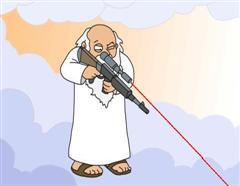
    First, it is important for evangelical Christians to reaffirm the truth that God is neither man nor woman.  God is portrayed in the Bible as being personal and involved, but never male or female.  “Indeed, the Old Testament avoids attributing sexual functions to God, on account of the strongly pagan overtones to such associations” (McGrath, 2007, p. 204).  Sallie McFague has said that, “God is she and he and neither” (Kraus, 1991, p. 96).  Norman Kraus also says, “To think of God exclusively in masculine gender turns him into an idol” (Kraus, p. 96).  Kraus goes on to argue that in each context it is important to find the right metaphors to use when talking about God (Kraus, p. 96).   However, because of the predominance of male language about God, I wonder if North America would benefit from more feminine language about God.  The Bible is full of this language (Hos 11:3-4,13:8 Deut 32:18, Isaiah 66:13, 49:15, 42:14 Mt 23:37 Lk 13:34, 15:8-10). God is described as one who gives birth, nurses, has a womb, and is like a mother bear.  In fact, when one begins to search the Scriptures for feminine language of God it does not take long to find an astounding number of verses.1 I once heard a prison chaplain who talked about how a card company gave a bunch of Mother’s Day cards to the inmates in a prison.  It was a huge success.  All the cards were taken and sent to the mothers of these inmates.  Because of the overwhelmingly positive reaction, the card company decided to do it again for Father’s day.  The result was the exact opposite.  Not a single card was taken by the inmates.  In a culture full of fathers who are absent, abusive, or both, there is value in recognizing and using the feminine language of the Bible to talk about God.  In the book, The Shack, William Young does this exact thing. Because of the main character’s own problems with the word “papa,” God chooses to be self-revealed as a black woman.  The “Family Guy god” reveals the need for us to more clearly articulate our belief that God is she and he and neither.

   Secondly, what do we mean when we talk about God’s omnipotence?  C.S Lewis stated the problem well, “If God were good, he would wish to make his creatures perfectly happy, and if God were     almighty he would be able to do what he wished. But the creatures are not happy.  Therefore God lacks either the goodness, or the power, or both” (McGrath p. 216).  It seems that this is part of what drives the “Family Guy god.”  If God is powerful, why is it that we are not all supermodels?  Why are some children born with malfunctioning hearts?  The answer lies in a better definition of what omnipotence means.  While the literal definition of omnipotence is that God has all the power and can do anything, the Christian understanding is different (Kraus, p. 81).  When we follow this first meaning of omnipotence we are quickly led to ridiculous questions about whether or not God can make a rock so heavy that he can’t lift it.  Stanley Grenz writes, “In contrast to such misguided discussions, to say, ‘God is omnipotent’ is to acknowledge that God is able to bring to completion the divine design for creation” (Grenz, 1998, p. 98).  Kraus points out that God’s omnipotence means that God is not locked into God’s created system.  “God is not limited to the causality of the so-called natural process” (Kraus p. 81).  Perhaps one of the most important things we can say about God’s omnipotent power is that it is exercised, “though self-limitation and defenselessness of the incarnation.... God in his own freedom     chooses to accomplish his goals through our freedom of response to him.  He joins with us in the struggle to overcome death and evil in such a way that his victory will also be our victory.  His power is for us.  It is not independent and exclusive of us, but inclusive of us” (Kraus, p. 82).  God has self-limitation of power, which gives us freedom.  At the same time, God still retains the power to see that creation is brought to its final goal.  God chooses to join us in the struggle and share power with us.  Perhaps the “Family Guy god” is not a poor reflection of God doing a sorry job of creating things, but of Christians failing to respond to the structures and sin in the world that dehumanizes and devalues those in the world.  Instead of wondering why God does not simply make the world a better place, perhaps the world should be asking what has the Church done lately to make the world a better place?  God will one day rule fully in all power and nothing will be able to stop this plan.  However until that day God has chosen to be self-limiting and to work primarily through those who respond to God’s call.

    Finally, the “Family Guy god” is disinterested in humanity; he is an absent god.  It is vital for Christians to speak up and remind all who will listen that God has not abandoned humanity.  Rather, God cared so much about this planet that the Divine became human.  God has suffered with humanity, so that God could restore humanity.  In the midst of all the difficult things that happen in life, God is the relational Being whose presence can be known.  When I think back to the bar scene, I know that God is, in fact, present in the bar, but God is present in a fundamentally different way than MacFarlane sees it.  MacFarlane sees God torching the place and running, whereas the incarnation shows me that God is in the bar suffering with those who suffer.  God has not left the world to burn.  God is present in it and will one day fully restore it into a new earth.

    The “Family Guy god” is nothing like the Christian God.  However, it does seem that the “Family Guy god” character is created from a number of misunderstandings and assumptions that are drawn from the language we use as North American Christians.  God is not a bumbling idiot who chases women, uses his power poorly, and fails to take an interest in the world he created.  Rather, God is she and he and neither, at the same time, God is personal!  God is actively involved in the lives of God’s creation.  God limits God’s power so that people can freely respond to God, and then God shares that power with us.  In the incarnation we see that God chooses to suffer with humanity, sharing our pain and sorrow.  We know that God is working towards a goal that will be accomplished.  I believe that, as Christians, it is important for us to respond to the “Family Guy god” in a way that carefully corrects these misrepresentations of God.  As Christians, we must watch the language we use about God.  We must take action and use the power God has given us to alleviate the things that are wrong in the world.  And we must continually remind people that God deeply loves humanity and the world, so much that God took on flesh to be among us.

Thursday, September 23, 2010

God the Idiot: Part 1

A few months ago I had to write a paper using a "cultural" text to talk about our understanding of God.  For my paper I chose the portrayal of God in Family Guy.  What follows is some of my thoughts about both the portrayal of God and ways that we should respond.

Recently I was watching the highly popular cartoon “Family Guy.”  The son, Chris, is talking about how he is afraid to try and do homework because there is an evil monkey living in his closet and says that he has proof that it exists there.  Peter responds, “You’ll have to do better than you did on your science exam, or than God did when he left the iron on too long on Ellen Barkins face.”  The scene cuts to a clip of God, distracted, ironing a lady on an ironing board.  He looks down and the conversation goes as follows:
God; “ Oh *$%#.”
Ellen; “How is it?”
God: “Get in the van we’ll put you in the 80s where you’ll pass for hot” (Family Guy Hannah Banana season 8 Episode 4 Two minutes in).

“Family Guy” is no stranger to insulting God.  In season 3, there is a scene where God is trying to pick up a girl at a bar.  He uses his finger to light her cigarette and a second later he makes the same motion and sets the girl on fire.  Then he proceeds to run away, leaving the girl and bar to burn down.  Most of the time I was just offended by these clips.  However, when I started to put them together, I noticed something about the way that God is portrayed in these clips.  Seth MacFarlane, creator of “Family Guy,” portrays God as old, male, pudgy, balding, and completely inept.  In fact, one could call MacFarlane’s god a bumbling idiot.

    What leads a person to picture God this way?  How do I as a Christian respond to MacFarlane’s portrayal of the God I love?  As I reflect on these clips, three things seem to me to be a driving force behind the “Family Guy god.” 

First is the idea in western Christianity that God is male.  For the non-believer, is it understandable that the logical path leads to gods being womanizers?  This was certainly the case for the Greeks, Romans, Ancient Mesopotamians etc.  In those cultures the gods were always sneaking around having sex with women.  As the culture in North America has shifted, it is little wonder that our predominant language of talking about God as male has led to a view of God being more like Baal or Zeus than like the God of the Bible. 

Secondly, I wonder how much of the Christians’ belief in God’s omnipotence plays into MacFarelane’s view.  If MacFarlane grew up within any proximity to Christianity, he would have heard about how God has all the power in the world; that God is able to do all things.  Yet, when one looks at the world, it is clear that things are not all good.  If God is all-powerful, why is it that some people are born with physical defects that will go on to limit them in life?  Children are born all over the world with abnormalities and diseases.  If God is the creator of all these lives, why would he not do a better job?
  
Finally, there is the idea that God is absent and disengaged from the world.  In the clip, “god’s” flippant remark to Ellen about getting into the van indicates that God can’t be bothered to fix his mistake.  Or perhaps an even better example is the scene of “god” setting the woman on fire with his finger.  His reaction is to run out of the bar after setting her on fire.  Our very language sometimes seems to indicate that this is the case.  When a hurricane or flood hits we call it an “act of God” and are then left asking “where was God in this?”  Did God just set the world in motion and then leave?  The world spirals into disaster and God can be seemingly absent.  In brief, the “Family Guy god” is a jumble of distorted images that come from the language we use to talk about God the Father.

Saturday, March 06, 2010

Biblical Interpretation (Don't worry it's funny)

Perhaps you wonder what it is that a M.A. Theology student spends so much money to learn.  Well I thought I would share with you some of the tools in Biblical Interpretation that a true scholar like me learns.  To do this, let us talks about how you exegete a Stop sign.

Suppose you're traveling to work and you see a stop sign. What do you do? That depends on how you exegete the stop sign.

1. A postmodernist deconstructs the sign (knocks it over with his car), ending forever the tyranny of the north-south traffic over the east-west traffic.

2. Similarly, a Marxist sees a stop sign as an instrument of class conflict. He concludes that the bourgeoisie use the north-south road and obstruct the progress of the workers on the east-west road.

3. A serious and educated Catholic believes that he cannot understand the stop sign apart from its interpretive community and their tradition. Observing that the interpretive community doesn't take it too seriously, he doesn't feel obligated to take it too seriously either.

4. An average Catholic (or Orthodox or Coptic or Anglican or Methodist or Presbyterian or whatever) doesn't bother to read the sign but he'll stop if the car in front of him does.

5. A fundamentalist, taking the text very literally, stops at the stop sign and waits for it to tell him to go.

6. A preacher might look up "STOP" in his lexicons of English and discover that it can mean: 1) something which prevents motion, such as a plug for a drain, or a block of wood that prevents a door from closing; 2) a location where a train or bus lets off passengers. The main point of his sermon the following Sunday on this text is: when you see a stop sign, it is a place where traffic is naturally clogged, so it is a good place to let off passengers from your car.

7. An orthodox Jew does one of two things: 

1) Take another route to work that doesn't have a stop sign so that he doesn't run the risk of disobeying the Law.
2) Stop at the stop sign, say "Blessed art thou, O Lord our God, king of the universe, who hast given us thy commandment to stop," wait 3 seconds according to his watch, and then proceed. 


Incidentally, the Talmud has the following comments on this passage: R[abbi] Meir says: He who does not stop shall not live long. R. Hillel says: Cursed is he who does not count to three before proceeding. R. Simon ben Yudah says: Why three? Because the Holy One, blessed be He, gave us the Law, the Prophets, and the Writings. R. ben Isaac says: Because of the three patriarchs. R. Yehuda says: Why bless the Lord at a stop sign? Because it says: "Be still, and know that I am God." R. Hezekiel says: When Jephthah returned from defeating the Ammonites, the Holy One, blessed be He, knew that a donkey would run out of the house and overtake his daughter; but Jephthah did not stop at the stop sign, and the donkey did not have time to come out. For this reason he saw his daughter first and lost her. Thus he was judged for his transgression at the stop sign. R. Gamaliel says: R. Hillel, when he was a baby, never spoke a word, though his parents tried to teach him by speaking and showing him the words on a scroll. One day his father was driving through town and did not stop at the sign. Young Hillel called out: "Stop, father!" In this way, he began reading and speaking at the same time. Thus it is written: "Out of the mouth of babes." R. ben Jacob says: Where did the stop sign come from? Out of the sky, for it is written: "Forever, O Lord, your word is fixed in the heavens." R. ben Nathan says: When were stop signs created? On the fourth day, for it is written: "let them serve as signs." R. Yeshuah says: ... [continues for three more pages]

8. A Pharisee does the same thing as an orthodox Jew, except that he waits 10 seconds instead of 3. He also replaces his brake lights with 1000 watt searchlights and connects his horn so that it is activated whenever he touches the brake pedal.

9. A scholar from Jesus seminar concludes that the passage "STOP" undoubtedly was never uttered by Jesus himself, but belongs entirely to stage III of the gospel tradition, when the church was first confronted by traffic in its parking lot.

10. A NT scholar notices that there is no stop sign on Mark street but there is one on Matthew and Luke streets, and concludes that the ones on Luke and Matthew streets are both copied from a sign on a completely hypothetical street called "Q". There is an excellent 300 page discussion of speculations on the origin of these stop signs and the differences between the stop signs on Matthew and Luke street in the scholar's commentary on the passage. There is an unfortunately omission in the commentary, however; the author apparently forgot to explain what the text means.

11. An OT scholar points out that there are a number of stylistic differences between the first and second half of the passage "STOP". For example, "ST" contains no enclosed areas and 5 line endings, whereas "OP" contains two enclosed areas and only one line termination. He concludes that the author for the second part is different from the author for the first part and probably lived hundreds of years later. Later scholars determine that the second half is itself actually written by two separate authors because of similar stylistic differences between the "O" and the "P".

12. Another prominent OT scholar notes in his commentary that the stop sign would fit better into the context three streets back. (Unfortunately, he neglected to explain why in his commentary.) Clearly it was moved to its present location by a later redactor. He thus exegetes the intersection as though the stop sign were not there.

13. Because of the difficulties in interpretation, another OT scholar emends the text, changing "T" to "H". "SHOP" is much easier to understand in context than "STOP" because of the multiplicity of stores in the area. The textual corruption probably occurred because "SHOP" is so similar to "STOP" on the sign several streets back that it is a natural mistake for a scribe to make. Thus the sign should be interpreted to announce the existence of a shopping area.

14. A "prophetic" preacher notices that the square root of the sum of the numeric representations of the letters S-T-O-P (sigma-tau-omicron-pi in the Greek alphabet), multiplied by 40 (the number of testing), and divided by four (the number of the world--north, south, east, and west), equals 666. Therefore, he concludes that stop signs are the dreaded "mark of the beast," a harbinger of divine judgment upon the world, and must be avoided at all costs.

And that my readers is how it is done.  :)

Thanks to Tim Geddert for introducing me and Tim Perry for this http://www.calvin.edu/~lhaarsma/hermeneutics_humor.html

Wednesday, March 03, 2010

Love Your Enemies

WARNING: This is a long post, but I don't have time to write something shorter.  I'm pretty busy here with family, but I wanted to post something since it's been a while.  This is a short sermon that I had to write for my Discipleship and Ethics class.  I think it's worth reading if you have a bit of time.   

  “Simon son of John, do you love me” (John 21:15)?  Here is the haunting question of Jesus as recorded by the Apostle John.  For me, the scene is a powerful one.  Jesus and Peter are standing beside the lake and Jesus asks the question that has been burning in His heart.  “Do you love me?”  Is it really such an odd question?  Peter: the Son of Thunder, the Rock, the man who recognized Jesus as the Christ, within the inner circle of Jesus disciples,  betrayer of Christ.  Where was Peter as Jesus suffered and died on the cross?  He was not there; he was not beside Jesus’ mother to comfort her.  No, Peter has betrayed Christ and fled.  “Do you love me?”  There is an invitation in those words.  It is the invitation to respond and return the love that is offered.  It is an invitation to the one who betrayed the Christ to come back into relationship.
    Not long before this scene, Jesus was sharing a meal with his disciples.  John sets the stage with heavy foreshadowing as he writes that the devil has already worked his way into Judas’ heart and that Judas has already made the decision to betray Christ (John 13:2).  Jesus, fully aware of what Judas is planning (John 13:21, 26), gets up from the table and takes on the posture of a servant.  In a humble act of service Jesus washes the feet of His disciples. The important point is that Jesus washes all of the disciples feet, even the dirty feet of the one who, in a few hours, will walk down a dusty road to betray him. 
    Sometimes it is hard for us to know what we mean when we talk about loving our enemies.  Is it the nation my nation is at war with?  While there is no doubt that we should seek peace and we certainly need to express love towards those people, they are often an abstract concept for us.  What is not abstract for us are those who have betrayed us. We can all remember the promises that have been broken, and the lies that have been told.  There is nothing abstract about the pain we feel when we have been betrayed, and we have all been betrayed.  Many of us have had friends who are no longer our friends because of real or perceived betrayals.  Our closest friends can become our enemies when hurt is left unchecked.  When bitterness, anger, and revenge are allowed to fester in our minds, even those we are close to can become our enemies.  It has happened to me.  I have lost friends because I have not lived a life of forgiveness.  Has it happened to you?  When the Pharisees asked Jesus what the most important law was, he replied that it was to love God and your neighbor, that this was the whole law.  To illustrate the neighbor, Jesus picks a Samaritan, a despised, heretical enemy of the Jews. This is what it means to love your neighbor.  It means to love your enemy as well as your friend; that is the law.
    In his own life, Jesus saw those close to him betray him and become his enemy.  For Peter, the betrayal was not the end.  Rather Jesus sought out the one who had betrayed him and extended his love.  One can only think that if Judas had been able to fight his demons for just three days, Christ also would have extended love, forgiveness, and a second chance to him as well.  What a beautiful scene this would have been, to see Jesus walk across the field and kiss Judas on the cheek and to hear the words, “Judas, I love you.  You are forgiven.”
    Brothers and sisters, Jesus is not just an example of how to love our enemies, our betrayers.  No, in the actions of Christ we can see the actions of God for us.  In the person of Jesus, God has taken on the form of the lowest servant.  Jesus came to serve, not to be served.  G.K. Chesterton writes, “There has fallen to earth for a token, a God to great for the sky” (G.K. Chesterton, Gloria in Profundis).  God is the mighty one.  The one who is too great for this world to contain.  God the creator, has come to earth for us, a token.  God’s heart was betrayed by Adam and Eve in the Garden.  God has been betrayed countless times since by us.  Yet still God comes hurtling towards us.  God’s grace, mercy, and love are like a volcano that explodes forth with unstoppable power and force.  Nothing can stand in front of this torrent.  We are engulfed and carried away in God’s love.  God comes not with judgement or anger, but with a question, do you love me?  Romans 5:8-11 says,

“For while we were still weak, at the right time Christ died for the ungodly.  In deed, rarely   
will anyone die for a righteous person - although perhaps for a good person someone might actually dare to die. But God proves his love for us in that while we still were sinners Christ died for us.  Much more surely then, now that we have been justified by his blood, will we be saved through him from the wrath of God.  For if while we were enemies, we were reconciled to God through the death of his Son, much more surely, having been reconciled, will we be saved by his life.  But more than that, we even boast in God through our Lord Jesus Christ, through whom we have now received reconciliation.” 

This verse reminds us that we have been the enemy of God.  We have stood in combat with God and we have fought against our rightful Lord. However, our rebellion, betrayal, enmity, will never be enough to dissuade God from loving us and creating a way to be brought into God’s family.  God’s most earnest desire is that you be reconciled; brought into the family of God through Jesus Christ.  God is love, and God’s love for each of us is such that God will not allow us to remain his enemies.  God’s love overcomes the barriers that hold us apart.  Forgiveness is extended, adoption into the family of God is offered.  Betrayals are set aside and Jesus walks towards us, kisses us on the cheek, and says, “I love you.  You are forgiven.”
    It is with this, the deluge of God’s love, in the forefront of our minds that we return to Jesus’ command to love God, and to love your neighbor, even your neighbor is an enemy.  Any action of love that we make towards those who have hurt us, betrayed us, will only flow out of the love we experience from Christ.  Only as we experience the resurrection power of love and forgiveness will we find the ability to also love our enemies.  When we learn to love our enemies, we will find that our world is opened; we are freed from our grudges and hateful burdens.  Life is better lived when we are at peace with our neighbor.  I also believe that in learning to love our enemy, we will also learn to love God more.  We love our enemies by learning to forgive as God has forgiven us. We can learn to forgive by releasing our bitterness, anger, and grudges.  It can seem like an impossible task to love our enemy.  How can I forgive someone who has hurt me so deeply, but we never learn to love our enemies alone.  None of us walk this path alone.  Rather, we are the reconciled community of Christ.  We experience the power and support of others as we learn to love our enemies.  As a justified community of love, we practice what it means to forgive, to extend grace, to live in peace, to disagree without breaking fellowship, and to be patient.  Learning these virtues with our brothers and sisters will better enable us to live a life of loving our enemies, betrayers, and neighbors wherever we are.  We seek to live lives that obey the command to love our neighbors and our enemies.  And when we fail, we acknowledge that God’s kingdom has not yet been fully established on earth and we pray with Jesus, “Your kingdom come” (Matt 6:10)
    So may we be grasped once again by the amazing story of how God moves towards those who have betrayed him. May we be moved by the great God who, in grace and love, rushes to embrace those who have warred against him.  May we recognize our own betrayal of God and reach out to hear God say, “I love you.  You are forgiven.”  And then, in turn, may we reach out to our own enemies and betrayers and pass on the words that we have heard. “I love you. You are forgiven.”  

Monday, February 22, 2010

Community

I had this sort of "ah ha!" moment last night reading Brueggemann.  He was writing about the challenges of Biblical Interpretation in an increasingly pluralistic society, and in a post-modern world where, "a perspective has the power to makes sense out of the rawness of experienced life, even though it cannot be 'proven' or absolutely established" (Texts under Negotiation p. 10).

So I am reading this and I come to his line, "In Christian faith, the specific form faith takes is of a certain ilk, practiced from a certain perspective that one embraces in the face of other, rival perspectives.... This posture does not claim to be objectively true, but it claims to be a position where one will stand at cost and at risk, so that in the end, the test of its validity is non longer logic or fact, but the expenditure of one's own life, which is the only thing that has final worth" (p. 10)

My first thought as I read this was, "This is why the witness of the believer Believing Community is so important." Yes folks, I caught myself half way through the word believer, and realized that it is not about how well I live out the Christian life on my own.  It is all about how I live out my Christian walk in community.  I really can't think of a more Anabaptist thought.  For me this marks a bit of a change.  Not that I haven't thought that community is important, but as I read more and more I am being reminded that when the Bible says "you" it usually means the church, not the individual.

Monday, February 15, 2010

Brew, Books, Bikes

I bought a new blend today.  It is a seasonally available coffee from Mexico. On the bag it says that it has a Milk chocolate and Hazelnut.  I am very excited to make myself a pot tomorrow morning.  Today was a great homework day. I finished reading The Art of Reading Scripture - by Davis and Hays and All Right Now by Tim Geddert.  So much reading to do this semester finishing a book is always a good feeling, and two makes me feel like I am doing really well.  Tomorrow will be another day of work, but maybe I'll try my hand at writing something as well.  

Today I also headed over to the DMV (since it was closed) and did some riding around their motorcycle test track.  I'm doing a little practicing so that I can get my full license.  Good times, I love riding on a warm sunny day. 

Sunday, February 07, 2010

Oh Canada!

The other day in my North American Religious History class we were discussing the differences between Canada and the United States (of which there are many).  As the sole Canadian in the class I thought that the best way to explain the differences was like this...

Monday, January 25, 2010

First Day of Class

So today is the first day of class for the semester!  I have just 1.75 hours left of freedom!  In just under two hours I will receive my first (of many) Syllabus.  Of course since I've had almost two months off, I have done some reading and I am sitting in a pretty good place for the start of the semester.  And I am actually pretty ready to get back in the class room.  Sitting around is nice, but it will be good to be busy again.  However, I can tell already that Monday's are not going to be my favorite day of the week.  Class all afternoon, just enough time to work out and grab a quick something to eat, and then class until 9, and then work for an hour or so cleaning the school.

Fortunately I was able to finish reading all the books I bought from Amazon with my Christmas money.  I had to read pretty fast the last two days to finish Miroslav Volf's Free of Charge, but I finished it this morning and now I am ready to just read school books for a while.  Free of Charge was excellent.  Because pretty much everything I read I relate to the subject of God's wrath, there were a few things that I wonder about.  However, if you are looking for an excellent book on the topic of giving and forgiveness this is a must read.  In church on Sunday they were talking about giving money and that sort of thing, and I kept wishing that the person preaching would have read this book.  It would have offered so much to his sermon.  Anyway that's all for now.  Peace