Tuesday, November 01, 2011

Jesus, My Father, the CIA, and Me: A Memoir of Sorts.

Jesus, My Father, the CIA, and Me by Ian Morgan Cron is a fantastic read.  In fact, I read the whole thing in one day, I simply could not put it down. 

Cron leads us through his journey with his family, through riches and poverty, through alcoholism and family struggles.  This is not a book that paints a false, and rosy picture of what it means to live for Christ, but because of that it invites the reader into real struggles, and healing.  It is amazing to read the way in which Christ is at work in both Cron's life, and ours as well. 

Forgive the cliche, but this book will make you both laugh and cry.  It is marvelously written and is one of my favorite memoirs in a while.

Disclosure of Material Connection: I received this book free from the publisher through the BookSneeze®.com bloggers program. I was not required to write a positive review; the opinions I have expressed are my own. I am disclosing this in accordance with the Federal Trade Commission’s 16 CFR, Part 255: “Guides Concerning the Use of Endorsements and Testimonials in Advertising.”

Tuesday, May 17, 2011

Unleashed - McManus

Let's get one thing out of the way.  This is McManus' book "The Barbarian Way." If you have read that book, you will be greatly disappointed when you buy this.  Thomas Nelson just re-released the book with a more female friendly title.

That said, this is a simple, but challenging book.  The basic premise is that we as Christians are not called to a domesticated religion, but a passionate faith in Jesus that will lead us into all sorts of crazy and exciting places.

One of the things I appreciated most about the book was the way in which McManus talked about raising his children in the faith.  By not giving them a domesticated religion, but rather introducing them to a wild untamed relationship with Jesus.  It is certainly worth pondering how to raise our children in a way that unleashes them to follow Jesus.

I thought it was a great little book.  The biggest problem with the book is that it is much easier to read than to put into practice.


Disclosure of Material Connection: I received this book free from the publisher through the BookSneeze®.com <http://BookSneeze®.com> book review bloggers program. I was not required to write a positive review. The opinions I have expressed are my own. I am disclosing this in accordance with the Federal Trade Commission’s 16 CFR, Part 255 <http://www.access.gpo.gov/nara/cfr/waisidx_03/16cfr255_03.html> : “Guides Concerning the Use of Endorsements and Testimonials in Advertising.”

Monday, April 11, 2011

The Sacred Meal Review

In "The Sacred Meal" Nora Gallagher shares her thoughts on the Eucharist (Lord's Supper, Communion, Sacred Mean etc).  She walks through three steps of taking communion the "waiting," "receiving," and "afterward."  Each had a few interesting reflections and insights that flesh out what we are doing when we come to Communion. 
Over all I was really hoping for something great out of this book.  I had never thought of Communion as a Spiritual practice, so I was interested to hear what Nora Gallagher was going to say.  Unfortunately this book was a disappointment.  While there were a few new insights that will enhance my participation in the Lord's Supper in the future, most of the book was lacking in any depth.  Perhaps most frustrating to me was her side comment that she supports an open table, but then failed to offer any theological or scriptural support for her position.  So far of all the books I have read in this series this was my least favorite.   I have to seriously wonder if Nora was the best choice for this book.  Surely there is someone else who could have had more theological, and biblical insight into this ancient practice.  Instead all we are left with is a few reflections that feel weak and aren't really worth reading.

Disclosure of Material Connection: I received this book free from the publisher through the BookSneeze®.com <http://BookSneeze®.com> book review bloggers program. I was not required to write a positive review. The opinions I have expressed are my own.

Thursday, March 03, 2011

Guest Post

Hey friends. I know I haven't blogged in forever.  But if you still check this from time to time.  Head over to the Pangea blog and check out my guest post there.  Link is below.

The End of Theological Discussion

Tuesday, January 04, 2011

100 Books in 2010

So last year I took up the challenge of reading 100 books in 2010.  I am sad to announce that I didn't make my goal.  In the end I only read 80.  Of course there were hundreds of pages of parts of books that I read, many many dictionary articles, and over 100 articles that ranged from 10-55 pages each.  But actual books that I read start to finish, 80.  I have decided that this years goal is 101 books for 2011.  I enjoyed keeping track of what I read and being able to look back over the list.  Most of these books were well worth the time to read.
For those who care here is my completed 2010 list:
1 Religious No More - Mark Baker *
2 Thirteen Moons: A Novel - Charles Fraizer
3 Interpretation First Corinthians - Richard Hays *
4 Take This Bread - Sara Miles
5 Justification - NT Wright
6 The Hidden Power of Electronic Culture - Shane Hipps *
7 Free of Charge - Miroslav Volf
8 Paul a Very Short Introduction - EP Sanders *
9 Revivals, Awakenings, and Reform - William G. McLoughlin *
10 A Wind In The Door - Madeline L’Engle *
11 The Gospel According to Lost - Chris Seay
12 The Art of Reading Scripture - ed. Ellen F. Davis and Richard Hays *
13 The Souls of Black Folk - W.E.B. Du Bois *
14Double Take -Tim Geddert *
15 All Right Now - Tim Geddert *
16 Jesus Matters - ed. James R. Kraybill and David W. Shenk
 17 A Multi-Site Church Road Trip - Geoff Surratt, Greg Ligon, Warren Bird
 18 Drops Like Stars - Rob Bell
 19 Ungodly Women - Betty A. DeBerg *
 20 The Story of Christianity Volume 1 Justo L. Gonzalez *
 21 The Story of Christianity Volume 2 Justo L. Gonzalez *
 22 Canadian Evangelicalism in the 20th Century - John Stackhouse Jr, *
 23 The Burning Land - Bernard Cornwell
 24 St. Patrick - Jonathan Rogers
 25 Texts Under Negotiation - Walter Brueggemann *
 26 Different Eyes: The Art of living Beautiful - Steve Chalke and Alan Mann
 27 The Little Book of Restorative Justice - Howard Zehr
 28 The Little Book of Biblical Justice -Christ Marshall
 29 The Act of Bible Reading - Edited by Elmer Dyck
 30 Reading Scripture with the Church: Toward a Hermeneutic For Theological Interpretation  -   A.K.M Adam, Stephen E. Fowl, Kevin J. Vanhoozer, and  Francis Watson. *
31  Between Two Horizons - Edited by Joel B. Green and Max Turner *
32 Sensual Orthodoxy - Debbie Blue
33  A History of Christianity in the United States and Canada - Mark A. Noll *
34 The Moral Vision of the New Testament - Richard Hays *
35 The Nature of Atonement - ed. James Beilby and Paul R. Eddy *
36 Mark: the way for all Nations - Willard Swartley *
 37 Inca Gold - Clive Cussler
 38 Proclaiming the Scandal of the Cross - Ed. Mark Baker *
 39 Christus Victor - Gustaf AulĂ©n **
 40 The Smell of Sawdust: What evangelicals can learn from their fundamentalist heritage - Richard J. Mouw.
41 Recovering the Scandal of the Cross - Joel Green and Mark Baker *
42 The Nonviolent Atonement - J. Denny Weaver **
43 Flickering Pixels - Shane Hipps
44 Listening For the Heartbeat of God - J. Philip Newell
45 Christians Are Hate-Filled Hypocrites… and Other Lies You’ve been told - Bradley Wright.
46 Harry Potter and the Philosopher’s Stone - JK Rowling
47 Believers Church Commentary: Mark - Tim Geddert *
48 I’m a Stranger here Myself - Bill Bryson
49 Let the Reader Understand - Robert Fowler *
50 Harry Potter: and the Chamber of Secrets - JK Rowling
51 What does the Old Testament say about God? - Claus Westermann
52 The Drama of Scripture - Craig Bartholomew and Michael Goheen **
53 Models of God - Sallie McFague*
54 Against the Tide - Miroslav Volf **
55 Restless Gods - Reginald Bibby *
56 Rethinking Christ and Culture - Craig Carter *
57 Exclusion and Embrace - Miroslav Volf **
58 Harry potter and the prisoner of Azkaban - JK Rowling
59 The Sacred Canopy - Peter Berger*
60 Brands of Faith - Mara Einstein*
61 Beyond Opinion - Ravi Zacharias
62 Harry Potter and the Goblet of Fire - JK Rowling
63 Holy Trinity Perfect Community - Leonardo Boff*
64 Harry Potter and the Order of thee Phoenix - JK Rowling
65 Pornland - Gail Dines
66 The Openness of God - Clark Pinnock*
67 Can God be Trusted - John Stackhouse*
68 No Future without Forgiveness - Desmond Tutu*
69 The Gospel According to Jesus - Chris Seay
70 Free of Charge - Miroslav Volf (yes I read it twice)**
71 The End of Memory - Miroslav Volf**
72 Harry Potter and the Half Blood Prince - JK Rowling
73 Harry Potter and the Deathly Hallow - JK Rowling
74 Embodying Forgiveness - L. Gregory Jones
75 The Magicians Nephew - C.S. Lewis
76 Celtic Prayers from Iona - J. Philip Newell
77 The Fort - Bernard Cornwell
78 Fasting - Scot McKnight
79 Practicing our Faith - Dorothy Bass *
80 Open Secrets - Richard Lischer *


I was asked after I posted this what my top five were.  In no particular order I think

The Hidden Power of Electronic Culture - Shane Hipps
Free of Charge - Miroslav Volf
The Moral Vision of the New Testament - Richard Hays
Models of God - Sallie McFague
The Sacred Canopy - Peter Berger

Honorable Mentions go to 


Take This Bread - Sara Miles
Fasting - Scot McKnight
Open Secrets - Richard Lischer
Revivals, Awakenings, and Reform - William G. McLoughlin 
Mark Commentary - Tim Geddert

* Means that it was a required reading for school
** Means that it was not a required reading for school, but was directly related to school I was doing.

Monday, December 20, 2010

Fasting - Scot McKnight

Scot McKnight is a fantastic author.  I greatly respect him, and so I was thrilled at the chance to review his book for The Ancient Practices Series on Fasting.  McKnight does not disappoint.  This is certainly one of the best books on fasting I have ever read.  He suggests that, "Fasting is the natural, inevitable response of a person to a grievous sacred moment in life" (xviii).  There are simply times when we are confronted with situations (our own sin, sin of a nation, death, etc.) That we need to bring our bodies into line with our prayers, emotions, and spirit.  Fasting is a whole body act.  McKnight shows that fasting is not an A to B resulting in C activity.  If we fast we are not guaranteed that our prayers will be more effective or that we will meet God in a special way, but rather that as we respond to A with B we may discover C in ways we didn't expect.  McKnight also calls for Christians to rediscover the practice of regular fasting as well as fasting before baptism, communion, and other important days in the church calendar.  This is a great book.  A must read.


I received this book free from the Thomas Nelson Publishers "Booksneeze" book review program.  I was under no obligation to provide a positive review.  
 

Wednesday, December 01, 2010

The Gospel According to Jesus

I first heard of Chris Seay through his book "The Gospel According to Lost." That was a great book with interesting insights into how faith and pop culture meet.  So I was excited to read his new book "The Gospel According to Jesus."  Seay's primary question for us is, "Is it possible that we have ignored Jesus - our wild, messianic King - and chosen to re-create Jesus in the image of the Pharisees themselves?  Seay got the Barna Research Group to do some studies on how Christians define "Righteousness" the result was that MOST people do not actually know what it means.  But here's the problem.  Seay does a poor job of explaining what it does mean.  As a whole I felt like the book falls flat.  With a title like "The Gospel According to Jesus," you would expect it to rock your socks off, but it doesn't even come close.  That said, it is not a bad book.  There are a few very interesting comments and lines.  So if you have extra time, a few extra bucks, and you like Chris Seay it is worth getting.  Just keep your expectations low.   

I received this book free from the Thomas Nelson Publishers "Booksneeze" book review program.  I was under no obligation to provide a positive review. 

Friday, November 19, 2010

Are you an average book reader?

My brother-in-law posted this on his blog.  I thought I would pass it on.
According to a recent study done by the BBC the average person has only read six out the one-hundred books on the list below. Most are classics but a few modern literary works are included. 

The titles highlighted in ORANGE are the ones I have read.And PURPLE I may have but I can't remember for sure.
1. Pride and Prejudice - Jane Austen
2. The Lord of the Rings - JRR Tolkien (More times than I can count)
3. Jane Eyre - Charlotte Bronte
4. Harry Potter series - JK Rowling (Honestly I am not quite done the series, but close enough to say I have done it)
5. To Kill a Mockingbird - Harper Lee (Listen to Q debate about the over hype of this book here)
6. The Bible
7. Wuthering Heights - Emily Bronte
8. Nineteen Eighty Four - George Orwell
9. His Dark Materials - Philip Pullman
10. Great Expectations - Charles Dickens
11. Little Women - Louisa M Alcott
12. Tess of the D’Urbervilles - Thomas Hardy
13. Catch 22 - Joseph Heller
14. Complete Works of Shakespeare (I haven't read them all, but I have read
All's Well That Ends Well, The Merchant of Venice, A Midsummer Night's Dream, Much Ado About Nothing, Taming of the Shrew (I really liked this one), The Tempest, Twelfth Night, Hamlet (many times), King Lear, Macbeth, Othello, and Romeo and Juliet (Also more than once).
15. Rebecca - Daphne Du Maurier
16. The Hobbit - JRR Tolkien (Again, more times than I can count)
17. Birdsong - Sebastian Faulk
18. Catcher in the Rye - JD Salinger
19. The Time Traveler’s Wife - Audrey Niffenegger
20. Middlemarch - George Eliot
21. Gone With The Wind - Margaret Mitchell
22. The Great Gatsby - F Scott Fitzgerald
24. War and Peace - Leo Tolstoy
25. The Hitch Hiker’s Guide to the Galaxy - Douglas Adams
27. Crime and Punishment - Fyodor Dostoyevsky
28. Grapes of Wrath - John Steinbeck
29. Alice in Wonderland - Lewis Carroll
30. The Wind in the Willows - Kenneth Grahame
31. Anna Karenina - Leo Tolstoy
32. David Copperfield - Charles Dickens
33. Chronicles of Narnia - CS Lewis (Do I need to even say that I have read all of them repeatedly, sometimes a whole book in one day).
34. Emma -Jane Austen
35. Persuasion - Jane Austen
36. The Lion, The Witch and the Wardrobe - CS Lewis (Why is this here... see #33)
37. The Kite Runner - Khaled Hosseini
38. Captain Corelli’s Mandolin - Louis De Bernieres
39. Memoirs of a Geisha - Arthur Golden
40. Winnie the Pooh - A.A. Milne
41. Animal Farm - George Orwell
42. The Da Vinci Code - Dan Brown (HIGHLY overrated)
43. One Hundred Years of Solitude - Gabriel Garcia Marquez
44. A Prayer for Owen Meaney - John Irving
45. The Woman in White - Wilkie Collins
46. Anne of Green Gables - LM Montgomery
47. Far From The Madding Crowd - Thomas Hardy
48. The Handmaid’s Tale - Margaret Atwood
49. Lord of the Flies - William Golding
50. Atonement - Ian McEwan
51. Life of Pi - Yann Martel
52. Dune - Frank Herbert
53. Cold Comfort Farm - Stella Gibbons
54. Sense and Sensibility - Jane Austen
55. A Suitable Boy - Vikram Seth
56. The Shadow of the Wind - Carlos Ruiz Zafon
57. A Tale Of Two Cities - Charles Dickens (I think this is one of Dicken's best).
58. Brave New World - Aldous Huxley
59. The Curious Incident of the Dog in the Night-time - Mark Haddon
60. Love In The Time Of Cholera - Gabriel Garcia Marquez
61. Of Mice and Men - John Steinbeck
62. Lolita - Vladimir Nabokov
63. The Secret History - Donna Tartt
64. The Lovely Bones - Alice Sebold
65. Count of Monte Cristo - Alexandre Dumas
66. On The Road - Jack Kerouac
67. Jude the Obscure - Thomas Hardy
68. Bridget Jones’s Diary - Helen Fielding
69. Midnight’s Children - Salman Rushdie
70. Moby Dick - Herman Melville (I've started it, but never finished. I think that is about par for the course).
71. Oliver Twist - Charles Dickens
72. Dracula - Bram Stoker (Also stared but never finished).
73. The Secret Garden - Frances Hodgson Burnett
74. Notes From A Small Island - Bill Bryson
75. Ulysses - James Joyce
76. The Inferno - Dante
77. Swallows and Amazons - Arthur Ransome
78. Germinal - Emile Zola
79. Vanity Fair - William Makepeace Thackeray
80. Possession - AS Byatt
81. A Christmas Carol - Charles Dickens
82. Cloud Atlas - David Mitchell
83. The Color Purple - Alice Walker
84. The Remains of the Day - Kazuo Ishiguro
85. Madame Bovary - Gustave Flaubert 
86. A Fine Balance - Rohinton Mistry
87. Charlotte’s Web - E.B. White
88. The Five People You Meet In Heaven - Mitch Albom
89. Adventures of Sherlock Holmes - Sir Arthur Conan Doyle
90. The Faraway Tree Collection - Enid Blyton
91. Heart of Darkness - Joseph Conrad
92. The Little Prince - Antoine De Saint-Exupery (not sure if I have read this)
93. The Wasp Factory - Iain Banks
94. Watership Down - Richard Adams
95. A Confederacy of Dunces - John Kennedy Toole
96. A Town Like Alice - Nevil Shute
97. The Three Musketeers - Alexandre Dumas (one of my all time favorite books)
98. Hamlet - William Shakespeare
99. Charlie and the Chocolate Factory - Roald Dahl
100. Les Miserables - Victor Hugo (I can't remember if I have read it or not)

In the end I have read 28, with a few more (like the Shakespeare's books) and a few that I can't remember if I have actually read it or notThere are a couple here that I would still like to read, and a few that are actually some of my all time favorite books (Three Musketeers, Tale of Two cities, Brave New World, 1984 to name a few).   I do have to admit though, that much of this is my mother's doing.  I am as well read as I am because of her.  A number of these books (read anything that sounds girly or is by Dickens) I have not actually "Read" as much as my mom read them to me.  But that reading to me sparked a love for books and good stories that I have continued on my own. 

Monday, October 25, 2010

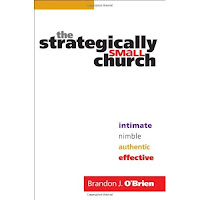
The Strategically Small Church

We can't all be mega-churches. In fact only half of one percent of churches qualify for that prestigious title.  Yet they influence nearly all of the church growth and strategic planning material that is consumed by the other 99.5% of pastors and churches.  The ironic thing is the effort and resources that those mega-churches put into trying to be like a small church.  The Strategically Small Church is a must read for pastors.  It sets out to encourage pastors and church leaders to view a new way of doing ministry.  It sets out to destroy the myth that bigger is better, and that growing numbers means a successful ministry.  I think that it is a very encouraging book for pastors of small churches, and should encourage a paradigm shift in the way that we think about our churches.  O'Brian will undoubtedly be criticized for not giving enough steps for small churches to practice what he has talked about, but that is the point.  The Strategically Small Church is not a how to manual.  It is a book that should encourage pastors to seek new ways of serving in the church they have, not the one they wish they had.  It is a book that will challenge many pastors, but one that is well worth the time to read.  I give it 5 Stars!    

Friday, October 01, 2010

Confessions of a TVholic

I love TV.  I watch lots of TV.  Probably more TV than I should.  I am pretty sure that there are better things that I should do with my time, but I don't.  However, that aside, the last two weeks have been premier week.  All the studios have released their new shows for us TVholics.  I remember a few years ago when I discovered the high attrition rate of new Television shows.  You find something you like and then two weeks later it has been canceled and replaced with something else.  That said there was one new show that I watched this last week that I liked.  No Ordinary Family is the story about a family that is falling apart and no longer connects with each other.  While on a family trip to try and 'reconnect' and build a stronger family they end up in a plane crash and all receive super powers.  Think The Incredibles but as a live action show.  As a TV show it is alright.  It isn't great... maybe slightly above average.  What I found most interesting is the portrayal of the Dad.  Dad's are not liked by mainstream television.  Think Peter from Family Guy, Hal from Malcom in the Middle, and by far the funniest, but also maybe the worst father, Phil from Modern Family (This is just a snapshot, the list goes on forever).  It isn't just comedies either.  Shows like Private Practice and Grey's Anatomy also tell stories of fathers who have been absent from their children's lives and are completely clueless.  This is where No Ordinary Family is different.  It is the father character who has been holding the family together.  It is the father who knows what is happening in the kids lives.  The father in No Ordinary Family is a genuinely good guy who loves his family and wants them to be together.  It is refreshing to see a good father on TV.  I really hope that this is something that we will see more of and that this show isn't canceled next week.        

Monday, September 27, 2010

God the Idiot: Part 2

In the previous post we looked at some of the characteristics of God as portrayed in Family Guy (Click Here for part 1).  Today we are going to ask how to respond.

What is the Christian response to the “Family Guy god”?  For some it is simply to call it heretical and blasphemous, and boycott it.  While I understand and sympathize with those feelings, we then miss the opportunity to respond to and correct the picture of who God is.  Instead we must respond by correcting the images that are out there.

    First, it is important for evangelical Christians to reaffirm the truth that God is neither man nor woman.  God is portrayed in the Bible as being personal and involved, but never male or female.  “Indeed, the Old Testament avoids attributing sexual functions to God, on account of the strongly pagan overtones to such associations” (McGrath, 2007, p. 204).  Sallie McFague has said that, “God is she and he and neither” (Kraus, 1991, p. 96).  Norman Kraus also says, “To think of God exclusively in masculine gender turns him into an idol” (Kraus, p. 96).  Kraus goes on to argue that in each context it is important to find the right metaphors to use when talking about God (Kraus, p. 96).   However, because of the predominance of male language about God, I wonder if North America would benefit from more feminine language about God.  The Bible is full of this language (Hos 11:3-4,13:8 Deut 32:18, Isaiah 66:13, 49:15, 42:14 Mt 23:37 Lk 13:34, 15:8-10). God is described as one who gives birth, nurses, has a womb, and is like a mother bear.  In fact, when one begins to search the Scriptures for feminine language of God it does not take long to find an astounding number of verses.1 I once heard a prison chaplain who talked about how a card company gave a bunch of Mother’s Day cards to the inmates in a prison.  It was a huge success.  All the cards were taken and sent to the mothers of these inmates.  Because of the overwhelmingly positive reaction, the card company decided to do it again for Father’s day.  The result was the exact opposite.  Not a single card was taken by the inmates.  In a culture full of fathers who are absent, abusive, or both, there is value in recognizing and using the feminine language of the Bible to talk about God.  In the book, The Shack, William Young does this exact thing. Because of the main character’s own problems with the word “papa,” God chooses to be self-revealed as a black woman.  The “Family Guy god” reveals the need for us to more clearly articulate our belief that God is she and he and neither.

   Secondly, what do we mean when we talk about God’s omnipotence?  C.S Lewis stated the problem well, “If God were good, he would wish to make his creatures perfectly happy, and if God were     almighty he would be able to do what he wished. But the creatures are not happy.  Therefore God lacks either the goodness, or the power, or both” (McGrath p. 216).  It seems that this is part of what drives the “Family Guy god.”  If God is powerful, why is it that we are not all supermodels?  Why are some children born with malfunctioning hearts?  The answer lies in a better definition of what omnipotence means.  While the literal definition of omnipotence is that God has all the power and can do anything, the Christian understanding is different (Kraus, p. 81).  When we follow this first meaning of omnipotence we are quickly led to ridiculous questions about whether or not God can make a rock so heavy that he can’t lift it.  Stanley Grenz writes, “In contrast to such misguided discussions, to say, ‘God is omnipotent’ is to acknowledge that God is able to bring to completion the divine design for creation” (Grenz, 1998, p. 98).  Kraus points out that God’s omnipotence means that God is not locked into God’s created system.  “God is not limited to the causality of the so-called natural process” (Kraus p. 81).  Perhaps one of the most important things we can say about God’s omnipotent power is that it is exercised, “though self-limitation and defenselessness of the incarnation.... God in his own freedom     chooses to accomplish his goals through our freedom of response to him.  He joins with us in the struggle to overcome death and evil in such a way that his victory will also be our victory.  His power is for us.  It is not independent and exclusive of us, but inclusive of us” (Kraus, p. 82).  God has self-limitation of power, which gives us freedom.  At the same time, God still retains the power to see that creation is brought to its final goal.  God chooses to join us in the struggle and share power with us.  Perhaps the “Family Guy god” is not a poor reflection of God doing a sorry job of creating things, but of Christians failing to respond to the structures and sin in the world that dehumanizes and devalues those in the world.  Instead of wondering why God does not simply make the world a better place, perhaps the world should be asking what has the Church done lately to make the world a better place?  God will one day rule fully in all power and nothing will be able to stop this plan.  However until that day God has chosen to be self-limiting and to work primarily through those who respond to God’s call.

    Finally, the “Family Guy god” is disinterested in humanity; he is an absent god.  It is vital for Christians to speak up and remind all who will listen that God has not abandoned humanity.  Rather, God cared so much about this planet that the Divine became human.  God has suffered with humanity, so that God could restore humanity.  In the midst of all the difficult things that happen in life, God is the relational Being whose presence can be known.  When I think back to the bar scene, I know that God is, in fact, present in the bar, but God is present in a fundamentally different way than MacFarlane sees it.  MacFarlane sees God torching the place and running, whereas the incarnation shows me that God is in the bar suffering with those who suffer.  God has not left the world to burn.  God is present in it and will one day fully restore it into a new earth.

    The “Family Guy god” is nothing like the Christian God.  However, it does seem that the “Family Guy god” character is created from a number of misunderstandings and assumptions that are drawn from the language we use as North American Christians.  God is not a bumbling idiot who chases women, uses his power poorly, and fails to take an interest in the world he created.  Rather, God is she and he and neither, at the same time, God is personal!  God is actively involved in the lives of God’s creation.  God limits God’s power so that people can freely respond to God, and then God shares that power with us.  In the incarnation we see that God chooses to suffer with humanity, sharing our pain and sorrow.  We know that God is working towards a goal that will be accomplished.  I believe that, as Christians, it is important for us to respond to the “Family Guy god” in a way that carefully corrects these misrepresentations of God.  As Christians, we must watch the language we use about God.  We must take action and use the power God has given us to alleviate the things that are wrong in the world.  And we must continually remind people that God deeply loves humanity and the world, so much that God took on flesh to be among us.

Thursday, September 23, 2010

God the Idiot: Part 1

A few months ago I had to write a paper using a "cultural" text to talk about our understanding of God.  For my paper I chose the portrayal of God in Family Guy.  What follows is some of my thoughts about both the portrayal of God and ways that we should respond.

Recently I was watching the highly popular cartoon “Family Guy.”  The son, Chris, is talking about how he is afraid to try and do homework because there is an evil monkey living in his closet and says that he has proof that it exists there.  Peter responds, “You’ll have to do better than you did on your science exam, or than God did when he left the iron on too long on Ellen Barkins face.”  The scene cuts to a clip of God, distracted, ironing a lady on an ironing board.  He looks down and the conversation goes as follows:
God; “ Oh *$%#.”
Ellen; “How is it?”
God: “Get in the van we’ll put you in the 80s where you’ll pass for hot” (Family Guy Hannah Banana season 8 Episode 4 Two minutes in).

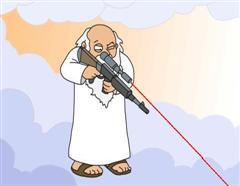
“Family Guy” is no stranger to insulting God.  In season 3, there is a scene where God is trying to pick up a girl at a bar.  He uses his finger to light her cigarette and a second later he makes the same motion and sets the girl on fire.  Then he proceeds to run away, leaving the girl and bar to burn down.  Most of the time I was just offended by these clips.  However, when I started to put them together, I noticed something about the way that God is portrayed in these clips.  Seth MacFarlane, creator of “Family Guy,” portrays God as old, male, pudgy, balding, and completely inept.  In fact, one could call MacFarlane’s god a bumbling idiot.

    What leads a person to picture God this way?  How do I as a Christian respond to MacFarlane’s portrayal of the God I love?  As I reflect on these clips, three things seem to me to be a driving force behind the “Family Guy god.” 

First is the idea in western Christianity that God is male.  For the non-believer, is it understandable that the logical path leads to gods being womanizers?  This was certainly the case for the Greeks, Romans, Ancient Mesopotamians etc.  In those cultures the gods were always sneaking around having sex with women.  As the culture in North America has shifted, it is little wonder that our predominant language of talking about God as male has led to a view of God being more like Baal or Zeus than like the God of the Bible. 

Secondly, I wonder how much of the Christians’ belief in God’s omnipotence plays into MacFarelane’s view.  If MacFarlane grew up within any proximity to Christianity, he would have heard about how God has all the power in the world; that God is able to do all things.  Yet, when one looks at the world, it is clear that things are not all good.  If God is all-powerful, why is it that some people are born with physical defects that will go on to limit them in life?  Children are born all over the world with abnormalities and diseases.  If God is the creator of all these lives, why would he not do a better job?
  
Finally, there is the idea that God is absent and disengaged from the world.  In the clip, “god’s” flippant remark to Ellen about getting into the van indicates that God can’t be bothered to fix his mistake.  Or perhaps an even better example is the scene of “god” setting the woman on fire with his finger.  His reaction is to run out of the bar after setting her on fire.  Our very language sometimes seems to indicate that this is the case.  When a hurricane or flood hits we call it an “act of God” and are then left asking “where was God in this?”  Did God just set the world in motion and then leave?  The world spirals into disaster and God can be seemingly absent.  In brief, the “Family Guy god” is a jumble of distorted images that come from the language we use to talk about God the Father.

Friday, September 17, 2010

God is Love: and the Flannel-graph

I saw this video today and I thought it was pretty sweet.  Perhaps best of all the video was constructed using felt.  The flannel-graph makes a come back!  What do you think?

Wednesday, September 15, 2010

Brrr....

It's cold.  It feels like winter. I really can't believe that I am not going to be in California when the snow starts to fly here.  These are my hobo mitts that I am wearing in the house.  I had Niki cut the tips of so that I can type, but at least the rest of my hands stay sort of warm.  In case you care, the book is Exclusion and Embrace by Miroslav Volf.  It is incredible!  One of the best books ever written.  If you have never read Volf, you need to.

Monday, September 06, 2010

Beyond Opinion

Beyond Opinion is a mixed book.  Since it is only edited and not written entirely by Ravi Zacharias some chapters are better than others.  The chapter by McGrath on a response to Atheism is by far my favorite  chapter in the book.  On the other side the responses to Post-modernism and Youth Culture were not very good.  I also really unsure what to do with the chapter on Islam.  We already live in a culture that has so much misinformation on Islam, and I am not sure if this chapter adds to this or clarifies things. 
All in all this book was pretty good.  If you have a chance pick it up and give it a read.

**Disclosure of material connection: I received this book free from Thomas Nelson Publishing as part of their BookSneeze.com book review bloggers program. I was not required to write a positive review. The opinions I have expressed are my own. I am disclosing this in accordance with the Federal Trade Commission's 16 CFR, Part 255: "Guides Concerning the Use of Endorsements and Testimonials in Advertising."